
STUDENT PROFILE
Committed to Healing People at Home
Amiyah McCoy, Mary Baldwin University
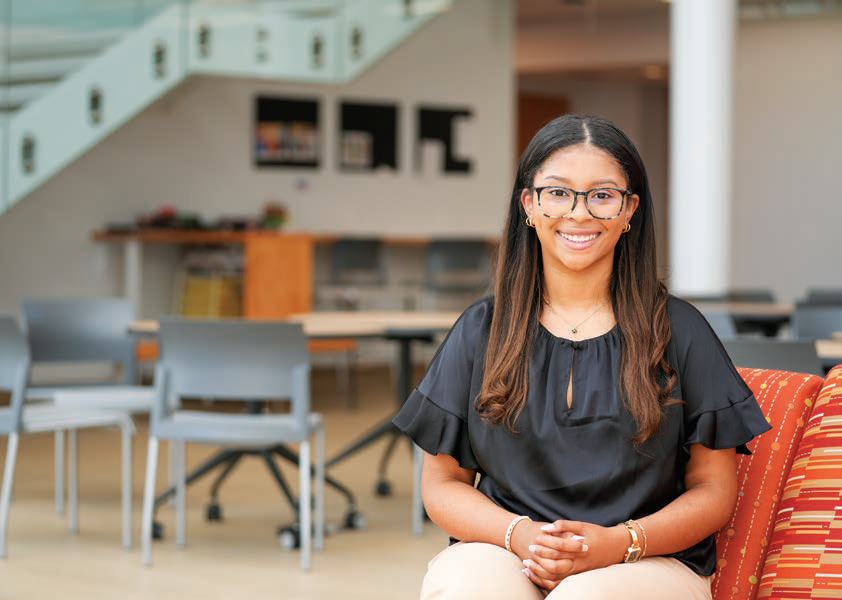
“My Granny Lena was my inspiration when I was deciding what to study in college,” says Amiyah McCoy, a 2025 graduate of Mary Baldwin University and Sentara scholarship recipient. “When I was just 13, her oldest daughter—my aunt—suffered a heart attack at home, several miles from the nearest hospital. Despite the paramedic’s best efforts, she didn’t survive. The event was heart-wrenching for everyone, especially my grandmother, who has struggled to trust the medical system ever since. It opened my eyes to a profound need in rural communities.”
Amiyah found her way to Mary Baldwin “thanks to” the disruption caused by COVID at the end of the 8th grade. She was 14. “The thought of online high school didn’t appeal to me at all,” says Amiyah. Her mother enrolled her in the Program for the Exceptionally Gifted (PEG) at Mary Baldwin, a program where younger students can start their undergraduate experience early.
Amiyah is currently earning her master’s degree at Mary Baldwin to become a physician assistant (PA). At the same time, she’s working at Raphine Medical Associates. There, she helps serve the acute care needs of long-haul truck drivers as well as people from Rockbridge and Augusta counties.
“The loss of my aunt made me realize that access to healthcare is not just about availability,” says Amiyah.
“It’s about building trust, making a connection, and meeting each patient where they are. Expanding healthcare access goes beyond simply placing clinics in underserved areas. It’s about helping people like my Granny Lena change their perception of medicine by making them feel comfortable seeking care. For me, that means being a person, not just a provider.”
That’s why making healthcare more approachable and accessible has become Amiyah’s life’s mission. She feels that becoming a PA is the first step toward bringing that mission to life. PAs complement physicians and other healthcare workers to make care accessible to more people, especially in medically underserved rural areas.
“More than ever, rural communities like mine need primary care providers who are not just willing but eager to practice,” says Amiyah. “Becoming a PA will allow me to make sure patients receive the care they deserve. When I return home as a PA, I want to be one of the providers that ensures that people like my Granny Lena—and all the many others in my community—are not just seen, but heard, counted, and cared for.”